Ed Blackwell
| Ratings (about) |
|---|
|
As leader: |
| Appearances: | Biography |
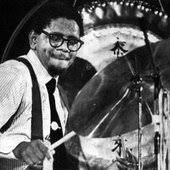
There are many talented jazz drummers but none have given the instrument such a voice as Ed Blackwell. He bridged bebop and post-bop drumming with ideas from New Orleans marching band, African poly-rhythms and Gamelan; his playing was song-like, complete, and called out to ideas of dance and community. His first breakthrough was getting Ornette Coleman's attention, he played on his quartet along with Scott LaFaro and, very notably, Don Cherry, with whom he would work very closely with in the future. He provided an explosive rhythm section with vast timbrel explorations on many records, with Ornette! being the best. It is fitting that for the birth of free jazz and Coleman's ideas of harmolodics which place equal importance on all aspects of music, the drums break from plain time-keeping and are played with deep vocabulary. The song T&T on Ornette! is a track dedicated purely for a Blackwell solo and an outstanding demonstration of his ideas: frequent tempo shifts, pitch-bending, highly organized streams of pulses and poly-rhythms. It is not a pretension for showmanship but a huge leap in the vocabulary and phrasing of jazz percussion. During this period he also worked with Eric Dolphy documented on the live recordings At the Five Spot, one of the most colourful jazz sessions of the time period in which he provided deep grooves and manic tempos, his rhythmic embellishments were as important as melodic counterpoint. He continued to work with Don Cherry after they both parted from Coleman's Quartet on the albums Complete Communion and Symphony for Improvisers, further refining his contributions to free jazz drumming with his song-like and structured playing suiting Don Cherry's suite compositions. After this he toured northern Africa where he found inspiration in the rhythmic ideas of the region, extending his vocabulary with dance and further poly-rhythms. His interest in ethnic/world music complemented Don Cherry and in 1969 they recorded the monumental "mu" first part/second part, a drum and trumpet duo. Don Cherry's performance called out to higher powers and Blackwell's eruptive rhythms served as a grounded counterpoint, connecting the spiritual and elusive with the physical and ritualistic. Together they formed a wholly unique musical language and a hermetic masterpiece. Blackwell reunited with Ornette Coleman in 1972 on Science Fiction and provided the drumming for many songs, the rhythm section within being one of the fiercest sounds ever recorded in jazz. A collaboration with Dewey Redman gave us Tarik and the live album Red and Black in Willisau on which post-bop drumming is stretched to it's experimental limit and Blackwell's polyrhythmic vocabulary is displayed full force on songs like We Hope. Blackwell played spiritual successors to "mu" with the two drum and trumpet duos of The Blue Mountain's Sun Drummer with Wadada Leo Smith and El Corazón again with Don Cherry. The abstract and philosophical depth decreased but Blackwell's drumming stayed lyrical as ever and pushed his aesthetic of dance and spiritual drumming further. Ed Blackwell passed away on October 7th 1992 from kidney failure, he played for many years with chronic kidney ailments, the two recordings Ed Blackwell Project: Vol I. and Vol II. documents his playing two months before his passing. |